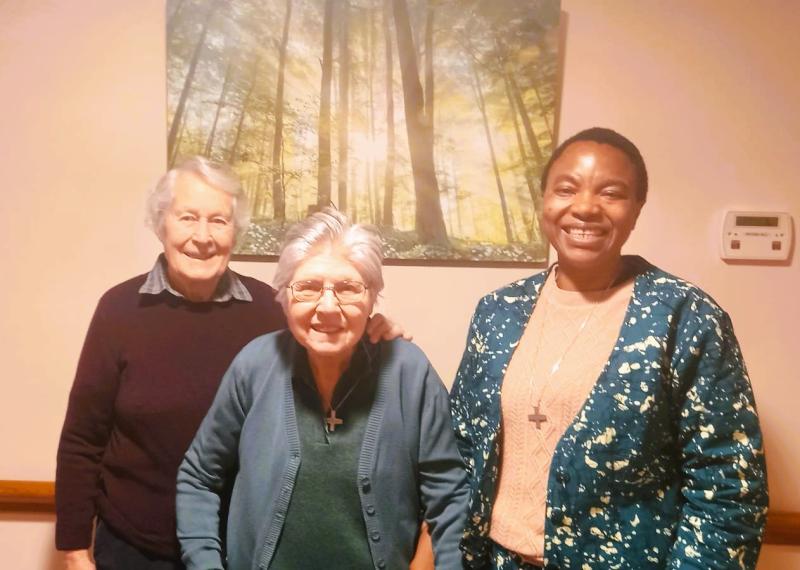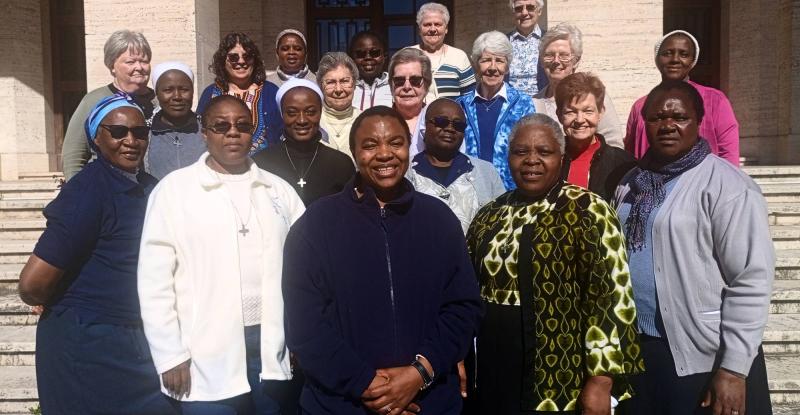
On February 14th and 21st, the Holy Union Sisters gathered online to reflect on interculturality as one of the main challenges and opportunities facing their communities.
Interculturality and diversity are not peripheral concerns for Holy Union; they are at its spiritual core. Father Roger Schroeder is a Divine Word Missionary Professor of Intercultural Studies and Ministry at Catholic Theological Union, Chicago, United States.
He guided the sisters through the concept of the Cultural Iceberg: like an iceberg, only a small part is visible above the surface, while a much larger part lies hidden beneath. The visible aspects include language, dress, food, music, customs, and rituals — the elements we readily notice when encountering another culture. However, the deeper and more powerful dimensions remain unseen. Beneath the surface lie values, beliefs, assumptions, attitudes toward authority, concepts of time, views on family, communication styles, understandings of power, and ways of expressing faith. These hidden elements shape how people interpret reality, relate to others, and make decisions. Often, misunderstandings arise not from what is visible, but from unspoken expectations and deeply held worldviews.
Intercultural living is a call to conversion for many congregations, for whom this remains "new territory," yet is increasingly perceived as essential for a viable international religious life. But it is a call addressed to all people of faith.
The formation included small group work to deepen the message and connect it with daily community life. A survey revealed that the sessions were greatly appreciated. Participants highlighted several key themes that resonated across cultures and continents. Many spoke of the importance of openness, listening, and learning from one another, recognizing that continual dialogue is the only path to truly understanding each other.
Closely linked to this was a renewed commitment to respect, acceptance, and the value of every person, captured simply in the words: "There’s no superior or inferior culture". Participants also embraced diversity as a gift and a source of enrichment, expressing gratitude for both the blessings and the challenges it brings. On a more personal level, many named self-awareness, growth, and transformation as central to the journey, acknowledging the need to recognize one's own cultural biases, assumptions, and fears before truly opening to another.
The connection between interculturality and the charism of Holy Union emerged as a profound insight: promoting interculturality is, at its heart, promoting God's Reign among people. Sisters also reflected on the concrete impact on community life and mission, with many finding the shared experience across areas and cultures particularly enriching. Finally, participants converged on a vision of interculturality as an ongoing process of dialogue and transformation, not a simple social exercise, but a profound spiritual journey requiring humility, deep listening, and the courage to navigate misunderstanding.

From this rich exchange, three guiding principles for intercultural living were proposed:
- Discover the dignity of difference. Difference does not diminish unity; it enriches it.
- Rethink how we think. Interculturality moves us from "either/or" to "both/and," from "us and them" to "we."
- Expand our image of God. The exclamation of Sojourner Truth — "Oh God, I didn't know you were so big!" — captures the awe that arises when we encounter God reflected in cultures different from our own.
As Sr. Caroline Njah, the Superior General, shared at the conclusion: "Interculturality begins in the heart. It grows through daily choices — how we listen, how we speak, how we forgive, how we collaborate, and how we love. The future of Holy Union will not be shaped by documents alone, but by our personal commitment to transformation. May we be courageous enough to examine our attitudes, humble enough to learn from one another, and generous enough to build bridges where there have been walls."
In embracing interculturality, Holy Union will live more deeply its Trinitarian call: a communion of diverse persons, united in love, witnessing to a world longing for unity in diversity.
By Maria Chiara De Lorenzo