
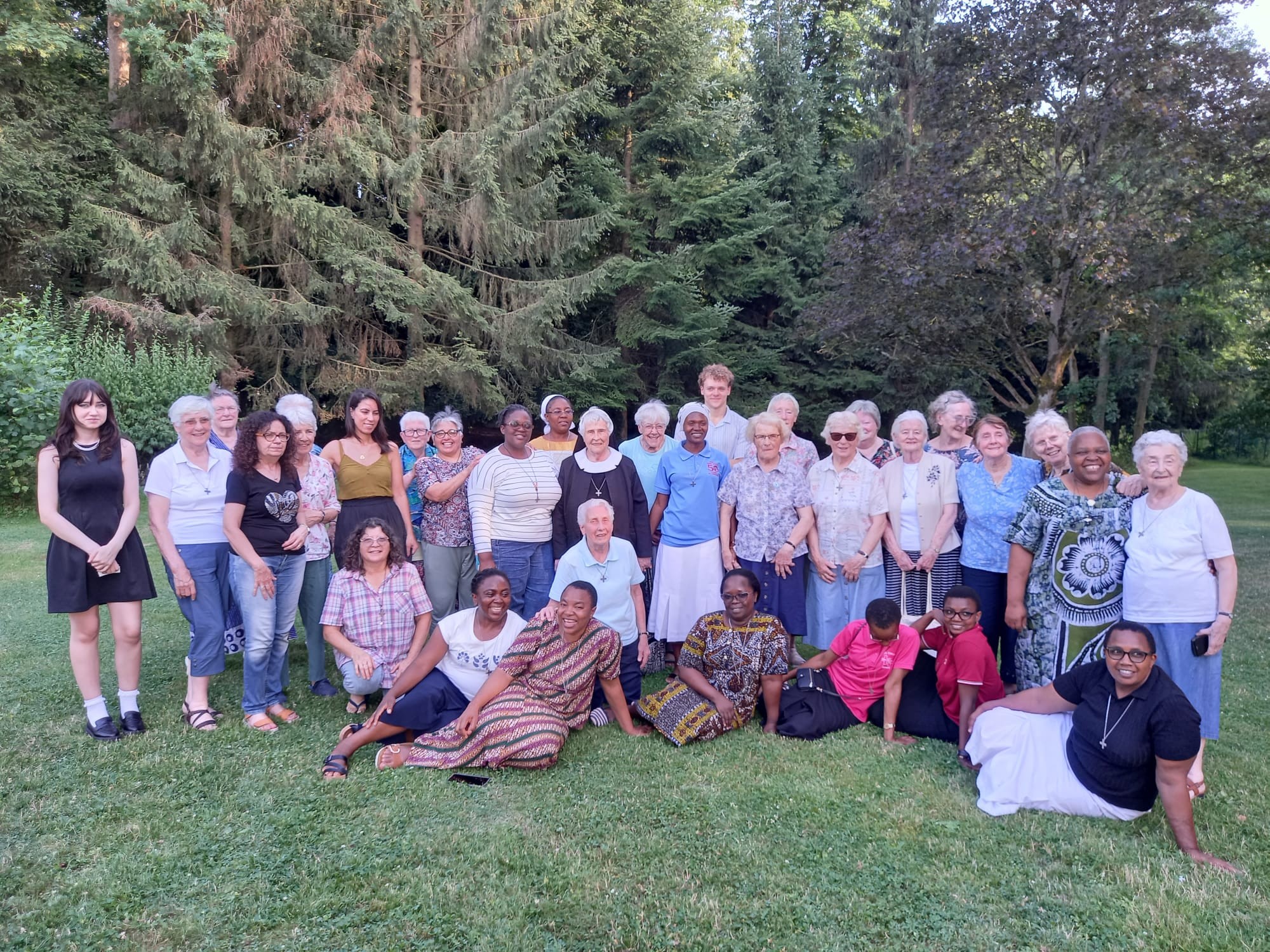
This month, Sr. Barbara Walsh leads a discussion with Sisters Alice Arsenault and Alice Michael about their recent bicentenary pilgrimage to Douai, the village of our founding, in the French countryside. Several dozen Holy Union Sisters from around the world joined them on this extraordinary journey, where they learned about, and experienced first-hand, our founder and the churches and people among whom our congregation was born. Their experiences touched them both deeply, and they will never forget the spiritual impact this pilgrimage had on them.
Note: The beautiful Holy Union bicentenary song at the end of this episode was composed by Nkwain Sam.
Hello and welcome friends to Called to Be, the podcast of the Holy Union Sisters. We are a congregation of Catholic sisters who are called to be at the heart of the world, revealing God's love. On our podcast, we discuss a wide range of topics around faith, spirituality, and our various ministries. We're so pleased you've chosen to join us today. To learn more about us, you can find us at www.holyunionsisters.org. My name is Sister Barbara Walsh, and I'm a Holy Union Sister. Today, we're speaking with Sisters Alice Michael and Alice Arsenault. Welcome, Sister Alice Michael.
Great to be here.
And welcome to you also, Alice Arsenault.
Thank you. It's wonderful. It's a joy to be here.
 So today, we will be discussing your recent pilgrimages to Douay, France and Foyenne, Belgium, which is the birthplaces of our congregation. Was there any reason why this pilgrimage was held at this particular time?
Oh, yes. This is our bicentennial. In other words, we are 200 years old and our sisters in Rome decided we needed to do something really big and important for everyone. So they suggested that we go back to our roots. And that was, as Sister Barbara said, back to Douai and Kain in Belgium. And we met some wonderful people that helped us to situate ourselves in the context of what the founder did and in a sense, is still doing through the people that are working in our schools. The schools in Belgium are very alive. We see the name Holy Union on the buildings of the schools where there are many lay people involved who have a great devotion to our founder. And 200 years ago, our founder worked on inviting women who were working in the parish and teaching young girls to do some needlework. He saw the need after the French Revolution to begin schools. So these schools are still very vibrant today. In fact, there are new schools still being built and the school right now that was in process of being open for September is going to be teaching how to run a hotel as well as the restaurant option of the hotel. So the schools are alive and well, and the teachers some of whom spoke to us about the foundation. And one gentleman actually said: “I love the founder, John Baptist Debrabant. He had a wonderful pedagogy with the children, and I still try to emulate his style with the children”. It just shows that when kindness is at the basis of what you're trying to do, it really carries through everything. And so I think this is the reason why these people are still devoted to not only the founder, but certainly God in working through these people.
Something that Sister Alice just said impacted me so much from the beginning is the joy, as though they knew him, the spirit. It's like Holy Union hasn't gone. Well, like in Belgium, we have schools, but even in France, there's still such a joy of remembrance. Which meant the impact that Father Debrabant had, but also his spirit and his openness to see as time changes and needs appear, they were trying to respond in different ways as she just brought out. That really impacted me because we are now, each one of us are going through different stages, but still on our mission to spread God's love. That really was strong for me.
Yeah, me too, Alice. These people were so full of joy in relating to us what the founder meant to them.
Were there any other people who joined you on this pilgrimage?
Other than our sisters? Well, we had the sisters from US, two of us, from Argentina, from Tanzania, from England, Ireland, France, Belgium, and Tanzania. And unfortunately our sisters in Cameroon could not get a visa. And that was very hard for them and for us to accept. But there were 10 of them that were supposed to have come and they had their name tag there. So we were invited to take one. Both Sister Alice and I both had the opportunity to take a name and we carried In addition to our own name tag, we had that person, that sister, Juliette. I had sister Juliette that we were carrying there with us in spirit. And since I've been communicating with her. So they were there, and that's your team from Rome. We have a few interviewers. And then people, as Alice just mentioned, joined us in so many beautiful sharings in the different days. There were Holy Union sisters. There where even associates. So we had an associate from England or Ireland who was excellent. So there were others that did broaden who was on this pilgrimage.
Was there any other reason why this pilgrimage was held at this particular time?
Well, June is always a celebration for us because we remember John Baptist, who was our founder's namesake. And so June 24th was and has been since our foundation very important to the whole congregation where we celebrate not only John Baptist, who preceded Jesus, the cousin of Jesus, but John Baptist Debrabant. And so the 24th was the highlight of this whole journey, which began on the 19th of June. It sounds like a short time, but there was so much that took place during that time. That time just flew by. There was a priest who really spoke about, he he wore founders chasuble. And that was powerful. And he had such a joy on his face as he celebrated and he pointed to the charitable. He was a young priest, but yet he, he just inspired such enthusiasm in remembering Father Debrabant.
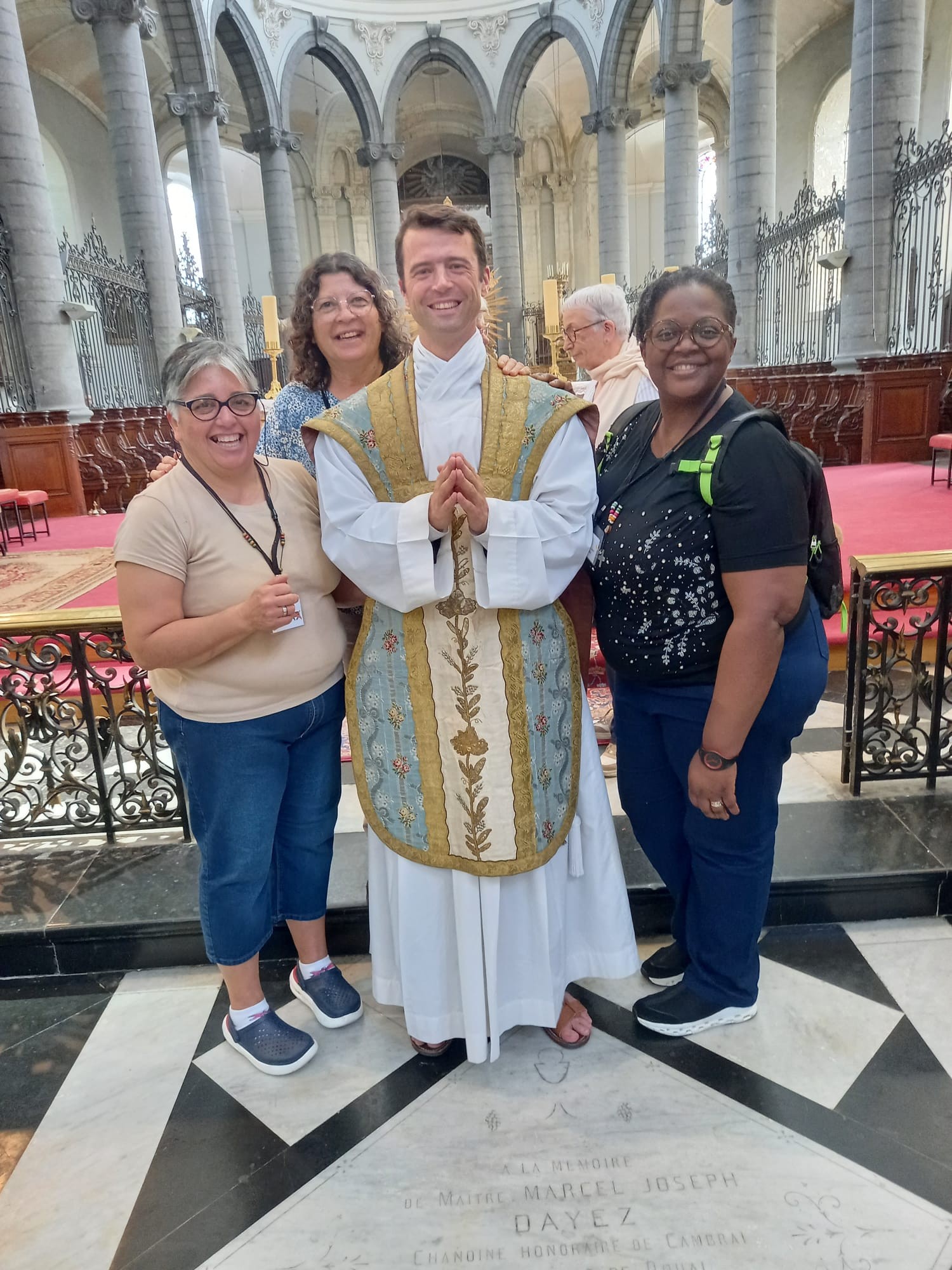
His name was Emmanuel Rousseline. But Emmanuel Rousseline as Sister Alice Michael said, is a young priest. And again, very devoted to the founder. In his church, there was a bust of the founder and there were teenagers. Remember Alice, there were teenagers who were brought in and quite a few lay people attended that particular mass. Many. Yes. And some of our sisters who live in the area, one who was very happy to be there, but also remembered by the lay people as having been a very active and loving sister. And I believe she worked with our people at Bethsaide. It was Bethsaide as a place for handicapped youngsters and adults. And Sister Teres was very, very active. And they also mentioned Sister Mary Veronique, who had been a member of the parish and led the choir. So for them to remember not just the founder, but certainly sisters who had been there very early on and even some lately.
Before this pilgrimage ever took place, we received several communications from the Generalate in Rome telling us, though we knew, but emphasizing that this was not a vacation, this was a pilgrimage that we were all on. And there are some things we should keep in mind, like that should bring us to a transformation in our own lives, as later on I'll be sharing different things. In other words, we didn't stay just in remembering our Holy Father, wonderful things, but even presently, and then where we're going with this, for we are still on mission. And that was very clear for us. And again, on the first day, we were very many times reminded that we're on a pilgrimage. Ultimately, every one of us who was baptized is on a pilgrimage toward our heavenly home, Heaven. Different people at different stages and at different relationships, but we're all on that pilgrimage. So that was important. That was like a setting for when we began.
Can you describe some of the areas that you visited so that we can visualize a picture of what they were like?
It's so difficult to try to describe, some of these churches are very old. In fact, if our founder was there, so the church has got to be 200 years old at least. And we know that the founder celebrated mass in several of these churches. And in fact, where Father Emmanuel, the one who wore Father Debrabant Chasuble, he said mass in a church where the founder’s confessional was still there. And they pointed that out to us.
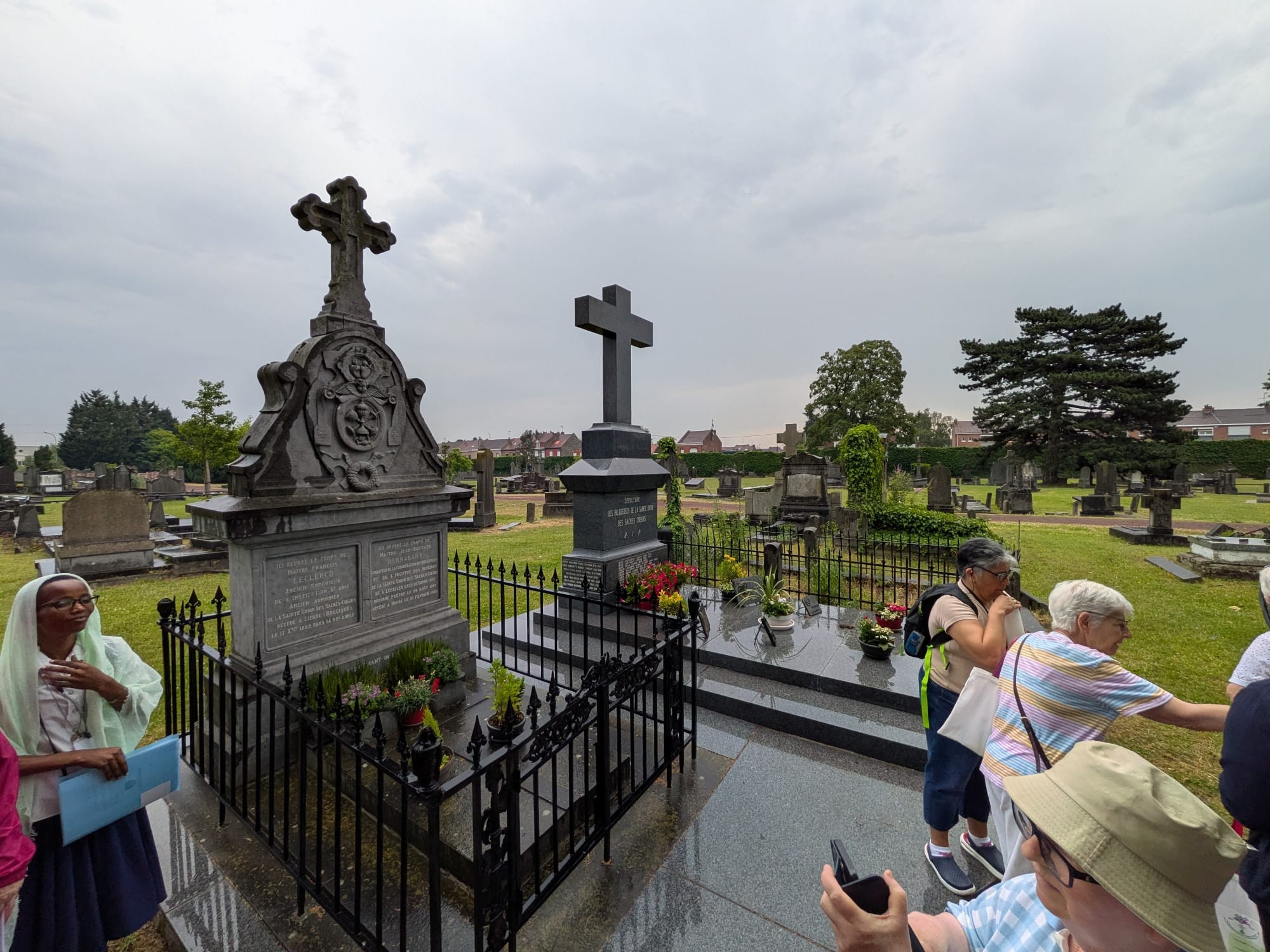
And visiting the cemetery, that day when we left Douai, there was no prediction of rain, so no one had an umbrella. Well, when it rained, it poured. Bus stopped and here we go with things wrapped around our head and umbrellas. And I mean walk to the cemetery. And it's a beautiful monument. But right next to his is our sisters who are buried there. And there was a woman and I'm having a difficult time remembering her name, who has such a love for Holy Union and commitment that she has taken on, that she takes care of, goes and cleans the area, she puts flowers on the days it's supposed to be. That was a very impactful moment for me also. In the midst of that pouring rain, he was standing before the very place where he is buried and where our early sisters and some still are buried. That was really quite a moment for me.
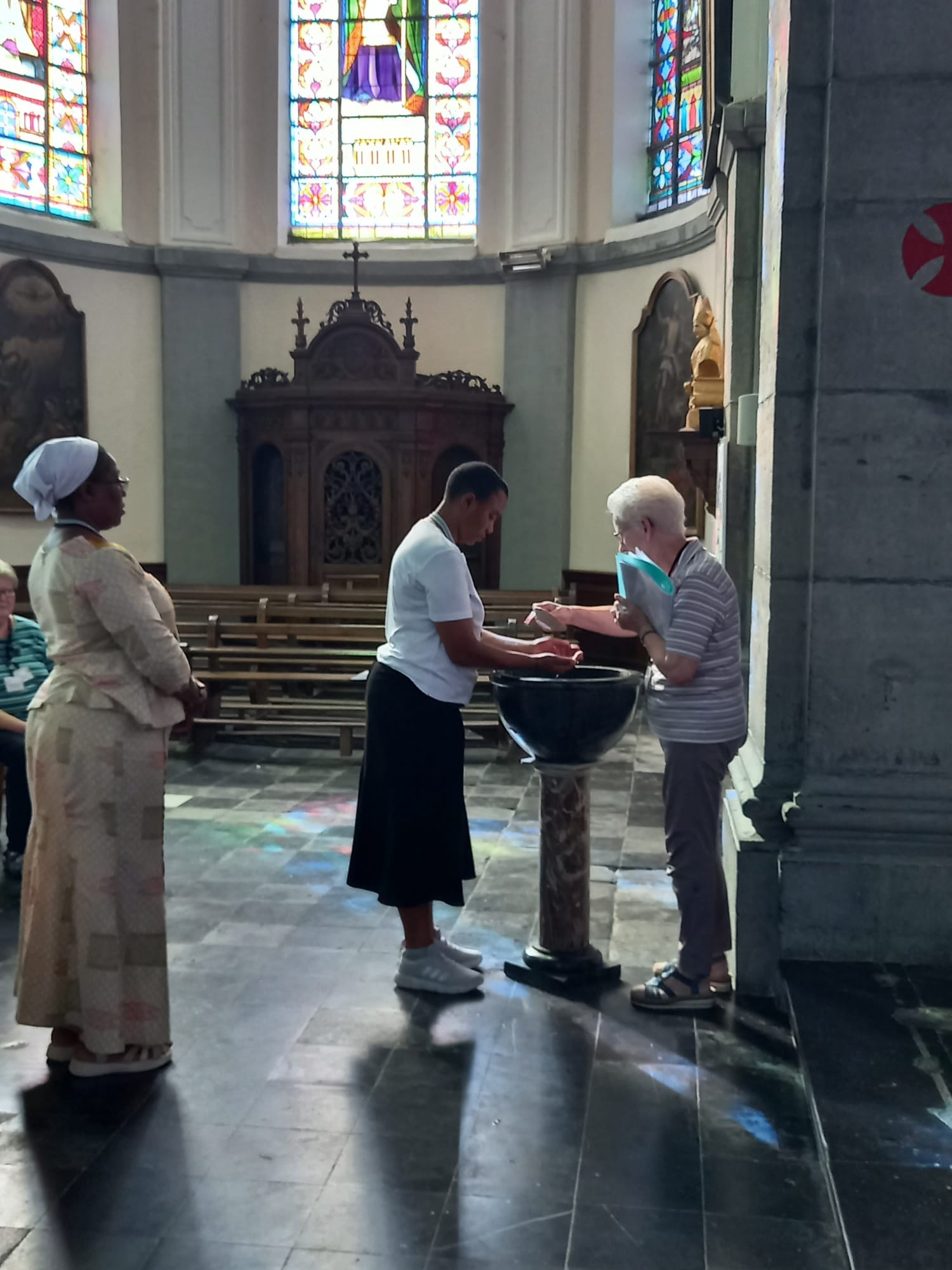
And one more place that made me very happy, toward the end, we went to the church where he was baptized and his, the baptismal front was there and they poured water into plastic and we renewed our own baptismal promises. And that was so meaningful because it's a baptism that was sent forth to reveal God's love. Everybody in some way had to reveal God's love and make him known. So that was very touching for me to be where he was baptized, but they connected to us. Okay, not just then, we were baptized and we too are called to continue living God's love and try to share it with others. So that was a big moment for me also.
I can help you to visualize a rural area where the houses are at least 200 years old. Some are brick and still people are living in them, but you can imagine little farms and also some very large farms where there's corn and wheat growing, fields and fields of vegetables being grown. Wonderful area of, I mean, if we could walk, but we were riding in a large bus where we were probably 40 of us because we had many people accompanying us, as well as our own sisters. The countryside is so, I want to say alive, because although we didn't see too many people, there are still people riding their bicycles through the countryside. There are some cars, but many on bicycles, and bicycles that are not electric, they're pedaled. And we're so accustomed to seeing these electric bicycles or scooters, but not there.
Yeah, let's put it in a way funny that there's nothing like New York City. Nothing like even Providence or Boston, as Alice just explained. For me, because I lived on a farm, to see all that vegetation was great. But one other thing that impacted me a lot was how the people, okay, the people in the area, even in transportation, so willing to help spontaneously. Wow, that was just so good. So good. Very different from what we're used to as far as like seeing people like I had expected on the farms to see people working. They must work at some hour. When we were going by, it's just all those fields where you didn't see workers actually doing the activity, you know, which was another experience.
A great example of people being so kind. Alice and I were on the train from Paris to Douai and we're in the car number one, because of a misunderstanding of something on the billboard, we had minutes to get to our gate. So Alice Arsenault can walk much faster than I. So we're practically running and they were closing the gate and they helped us get in and the train moved. We found out after we were on that because it was going to Douai, it would stop at one point and we'd have to move from, I think we were in cars 17 down to five, low and behold, it came down, what a storm, rain, pouring, lightning, thunder, and the train stopped. Alice and I, we both looked at one another, now what do we do? A young couple, I mean, you see what the weather was like? They just said, go, we'll take care of your luggage. And we were so trusting, we began walking as fast as we could because we're getting wet. Got in and we'd say to one another, well, where's our luggage? No, it's over there. We found it. Okay. We go, we go, we go. The train stops and it says the lightning has struck and we've lost our electricity. We will wait. So we sat there and we sat there and we sat there. Finally, Train went. We go and we go and we go. Oh, it stopped again. Another announcement. The storm knocked a tree on the tracks. We must wait for it to be cleaned off before we continue. So we stay and we stay and we stay. Some people, I guess, went living too far from there. A few people near us got off and said, we're going to get home another way. Okay, finally, we go. Then we get to Douai. This is to show you how good people are. We get to Douai and all these signs about where to go for a taxi. And a gentleman came up to us and said, Could we help you? We just said, Well, we want to go. Follow me. And I mean, it was walk here, go in this elevator, turn right, turn right. We tried to tip him. We would not take a penny. Okay, there, there, he showed us. Fine. Sister Alice Arsenault runs to make the call that it says, and we wait and we wait and no taxi appears. We're waiting. It's getting darker, you know? Okay. Do you know a man came, he had picked up his wife, Sister Alice, who speaks French, went up to him, explained, and he called a taxi. He said, they'll be coming. He left. We wait and we wait, no taxi. Do you know that that man came back a half hour later to see if we had gone? And there we were. He called another, I don't know what. He said, within a half hour, he'll be here. Sure enough, this car comes with no signed taxi. So Sister Alice looks at me and said, it can't be. It's not a taxi. But something in me told me, this is the car. So we walk up and yes, yes. It's that when you're learning to be a taxi driver for one year, you're on probation and on call and you don't use an official car, you use your own and also when they need it. So he took care of us, brought us home. It was just an incredible experience of people reaching out to strangers and not in the best conditions the hour of the night, etc. I'm sure, Sister Alice, that was your inner feeling. It was just so great.
Well, I think it's just another example of God working with us and helping us because we were going on this pilgrimage and we were already in prayer trying to get to our destination hotel, St. Amand-les-Eaux. That was the name of the hotel where we were. It was a hotel run by religious women who were working in the hotel and were providing hospitality for our sisters, all of us.
And they were wonderful because that night Sister Alice and I arrived late. Our sisters were there waiting and somebody from the hotel. Argentina arrived two o'clock in the morning because they couldn't get a taxi. And yet they were there and were given something to eat , it was just incredible. The spirit of giving, of self-giving. It was wonderful. Wonderful.
What would you say was the highlight of this whole pilgrimage for each of you and why?
I have to say that the first day that our major superior, Sister Caroline, spoke to us about this reflection that she had at Easter time. And it was very apropos for where we were and what we were doing. She recounted that after Jesus' resurrection, he met the disciples along the road to Emmaus. And she said to us, this is what we are called to do. Jesus told the apostles to go back to Jerusalem and that he would meet them there. We were called to go back to Douai and to Kain in Belgium. And that was where our founder was calling us, God calling us through our founder. And we were told to go back and renew that commitment that we've made so many years ago. And in fact, probably make every day because it has to be renewed. Sister Caroline was wonderful in helping us to remember that we too are following Jesus.
When she mentioned going back to Galilee and that we were there, that was a high point for me also, because ultimately every one of us have gone back to Galilee and we've been set forth through our baptism and through our dedicated life, so though every single baptized person is called. When we, the first day, I believe, Sister Michelle, who was on the team from Rome, spoke about this pilgrimage being a revelation. At first, I kept looking at it, saying, Hmm. But you know, for me personally, it was a great revelation in the sense that as a postulant novice, and we've learned a lot about Father Debrabant, about our first sisters, but that the pilgrimage experience revealed to me a deeper or a different level of knowing what they you know, how they thought, how they viewed their mission. And that was very it was like a new revelation to me.
And then the other piece that they kept the last day that we had to share. How are we going to share what we experienced with our sisters through this podcast? And they kept mentioned legacy, the legacy that Father Debrabant left us. We're still living on and growing in it. And then we were questioned, what is your legacy to be? Alice Michael, what is your legacy to be? And I have to be honest, since I'm back, I keep thinking and I keep asking, And I think every one of us is asking, religious, layperson, whoever, is asked, what legacy do we want to leave? And I don't mean monetary. I mean other points that we want to leave behind. And then that we ended with the baptism sending us forth in a way brought us back to Galilee, that we were being sent forth to continue our mission. I just found that. And another thing, it's still bothering me. The last days before we went and then again during the pilgrimage was that we should be changed persons after this pilgrimage. It should in some way transform us. So I, in my prayer each day, I think, okay, how has that changed and what do I see in me that needs to be changing and transforming? So that's an ongoing process. And I'm sure you feel the same way Sister Alice. We're not finished.
I sure do. I think you hit the nail on the head on that one because although we were called only two of us from the United States, It's interesting how God works because who knew that this whole experience with being called would impact us so deeply because we've been around for a long time and to have that brought back to us about what is your legacy. That is so important because today I think we need to be reminded, each one of us, as you said, religious or not, no matter what your role in life is, we are all called to remember who we are and why we are here.
It is. And that's, I think, the image of all the literature that we see that had those figures pointing to the left in the middle and then to the right. To the left was the history, the history back, okay. The middle one would be like where we are now, but we can't say where we are now, any one of us. But forward, we have to keep moving forward. That's why the call to conversion, to transformation, we're constantly, but where are we going forward to? Our pilgrimage to heaven.
Right.
Yeah.
Right. One of the things that I want to remind us of is one of the first day that we were together, there were scarves in the room where we were gathered. And the scarves were all different colors. And those scarves formed a heart at the very front and center of the room. And inscribed on a piece of cardboard was from the heart of Douai to the heart of the world. And that inscription stayed with us all the way and is still very much in my heart. And I'm sure in yours, Alice.
And remember, Alice, when we were asked to go and take a piece of the cloth, they were two pieces of light, but not near one another. Take a piece of the cloth and bring it. Okay. So that then you went to look for the I had a piece of green. I looked for the sister that had green, and it happened to be Sister Aurelia from Argentina. I mean, how better could it be planned? She could speak Spanish and know English, and I'm bilingual, so it was great. So whenever we met to share, she was my partner. But the other point was, when those pieces of cloth were left, was empty, but worse than empty, we are the heart. See, from the heart of Douai, to the heart of the world, but who the heart is? All of us.
Right.
You know, that was powerful also.
And I had an orange cloth, but so did three others. So not only did I have one prayer partner, but I had three others and we connected with one another. And so it's great because one of the people lives in Rome and well, two of the people live in Rome because one was on our team and the other is Loredana and the third one is from England. So that's our prayer partners. Before we conclude our podcast of today, I would like to share a little prayer that was given to me some almost 50 years ago. And it's a very powerful prayer that I think can address each and every one of us because it does apply. Never let me forget, I am a pilgrim on the way home. Teach me to seek you, meet you and know you as I travel the way. Especially I pray that you give me faithful companions who will let me rest but never stop, who will challenge me in my comfortableness, strengthen me in my weakness, support me in all the sufferings all journeys involve, and share with me the joy of traveling, seeking and finding our way home together. And this I ask through Christ, your son and the pilgrim, now and forever. Amen.
Thank you for sharing that beautiful prayer with us. It certainly will give us much to think about and pray in reflection about. Well, it's time to bring this episode to a close. I want to thank Sister Alice Arsenault, and Alice Michael, and of course, our listeners for joining us today. I hope you found this discussion meaningful. Just remember, you can listen to Call to Be directly from our website at www.holyunionsisters.org in addition to all the major podcasting platforms. May God continue to bless you and yours in all that you do. And please join us the next time on Called to Be. And remember, we are all Pilgrims.